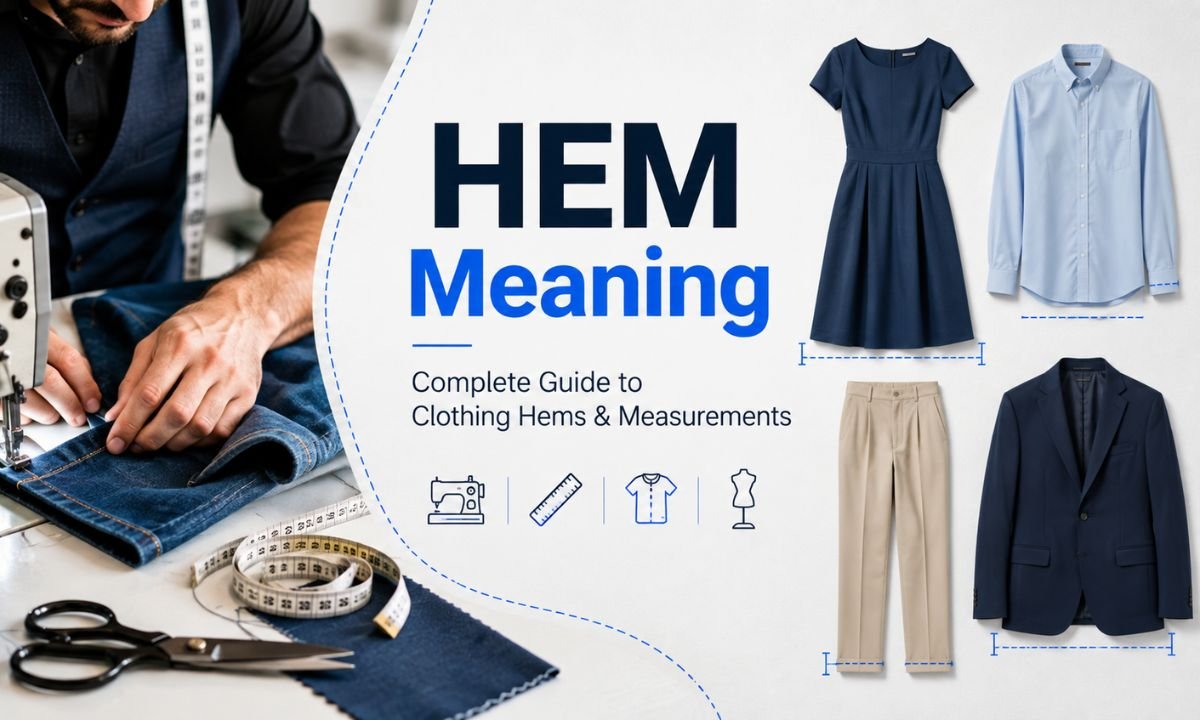

A hem is the finished edge of a piece of fabric or clothing, created by folding the raw edge under and stitching it down to prevent the threads from fraying. You’ll find hems at the bottom of shirts, dresses, pants, and jackets, and the word also shows up in measurement terms like “hollow to hem” and in the Bible, where it refers to the fringed edge of a garment. This guide walks through every common use of the word, from sewing rooms to scripture.
What Does Hem Mean?
At its core, a hem is a finished edge. When fabric is cut, the raw edge frays and looks unfinished, so tailors fold that edge under and stitch it flat.
That folded, stitched edge is the hem, and it’s one of the most basic techniques in garment construction. Every pair of pants, every t-shirt, and every curtain panel has at least one hem somewhere on it. Without it, clothing would slowly unravel every time it went through the wash.
The word also works as a verb. When someone says they need to “hem” a pair of pants, they mean shortening the fabric and sewing a new folded edge at the bottom, which is why tailors and dry cleaners advertise “hemming services” as a standard alteration.
Cambridge Dictionary defines hem plainly as the edge of a piece of clothing or cloth that has been folded under and sewn, and as a verb, to sew that hem in place. Merriam-Webster and other major dictionaries describe it the same way, calling it the edge of a piece of cloth that is folded back and sewn down.
Where the Word Hem Comes From
The word has old roots. According to Dictionary.com, in Old English, the word hem means “a border.” That original sense of “border” or “edge” has barely changed over a thousand years.
Collins Dictionary traces it further back, noting the term likely descends from Old English, akin to Middle Low German ham, an enclosed piece of land, from an Indo-European root meaning to compress or impede. The same root gives us the word “hamper,” which shares that sense of enclosing or holding something in.
That etymology matters because it explains why “hem” has a second, unrelated meaning: to hem someone in. YourDictionary notes the word traces back to Old English hemm, related to Middle High German hemmen, meaning “to hem in,” and Old Norse hemja, meaning “to hem in, restrain.” Both branches, the sewing term and the “surround and confine” sense, come from that same idea of a boundary.
Hem Meaning in Clothing: The Basic Definition
In clothing, a hem is almost always the bottom finished edge of a garment. It’s the part you’d shorten if a dress were too long, or let out if a growing kid needed more length in their pants.
Dictionary.com puts it in the simplest possible terms, describing the hem as the very bottom, folded edge of a piece of clothing, and pointing out that most of your clothes have at least one hem in them — at the ends of your sleeves, the bottom of your skirt, or along the edge of a t-shirt. That’s a useful reminder that hems aren’t only found at the bottom of a garment; sleeve cuffs, necklines, and armholes can all be hemmed too.
Wikipedia’s overview of the technique explains the mechanics well, describing a hem as a garment finishing method in which the edge of a piece of cloth is folded and sewn to prevent unravelling of the fabric and adjust the length of the piece in garments, such as at the end of the sleeve or the bottom of the garment. That second function, adjusting length, is why hemming is also the standard way tailors shorten clothes.
Quick Definition Box
| Term | Meaning |
| Hem (noun) | The folded, stitched edge of fabric or clothing |
| Hem (verb) | To fold and sew that edge down |
| Hemline | The level or position where a skirt, dress, or coat ends |
| Hem allowance | The extra fabric left for folding and stitching |
| Raw edge | The unfinished, unsewn edge of cut fabric, before hemming |
Why Garments Are Hemmed In The First Place
A hem does more than look tidy. It stops fraying, it adds a small amount of weight so fabric hangs correctly, and it lets a garment be shortened or lengthened later without recutting the whole piece.
Fraying happens because woven fabric is made of interlaced threads, and a cut edge has nothing holding those threads together. A folded, stitched hem locks the threads in place so they can’t work loose in the wash or with everyday wear.
The weight factor matters more than most people realize. A heavier hem allowance on a flowing skirt helps the fabric drape and swing properly, which is one reason wedding gowns and formal dresses often use deeper hems than casual clothes.
Finally, a hem is reversible in a way raw fabric isn’t. Because there’s extra fabric folded up inside, a tailor can often let a hem down to add length, which is exactly why parents keep letting out the hems on kids’ school pants as they grow.
Types of Hems: A Complete Breakdown
Not every hem looks or works the same way. The type of hem depends on the fabric, the garment, and the finish a designer wants.
Straight Hem
A straight hem runs level all the way around the bottom of a garment, with no rise or dip anywhere along its length. This is the most casual, most common finish for t-shirts, boxy tops, and everyday trousers.
On dress shirts specifically, Proper Cloth explains that the straight hem is a popular choice for casual, and particularly untucked, shirts, cut straight across all the way around the bottom, with a 2.5-inch vent in the bottom of the side seam on each side. That vent detail matters because it keeps the shirt from riding up or pulling tight when it’s worn loose over pants.
Curved Hem
A curved hem rises gently at the side seams instead of running perfectly level. Truekung describes this style as one that rises at the side seams and adds a slight drop front and back, which slims the hip visually and flatters movement, helping smart casual looks.
You’ll see curved hems most often on dress shirts, camp shirts, and fitted tops designed to be worn either tucked or untucked without looking sloppy.
Shirttail Hem
A shirttail hem dips lower at the front and back than at the sides, creating two rounded “tails.” Nimble Made sums up the practical difference simply: a curved hem is made to be tucked, a straight hem is cut for untucked casual shirts, and a shirt-tail hem is longer in back so it stays tucked.
Proper Cloth adds a specific measurement detail, noting the rounded hem typically features a 2-inch rise on each side of the shirt, curving up toward the side seams, giving a rounded shape to the front and back shirttails. Many quality shirts reinforce this point with a small gusset, a stitched reinforcement that keeps the fabric from tearing at that high-stress curve.
Open Hem
An open hem is a bottom edge left unfinished, without folding or stitching. Wordans’ glossary describes it as the bottom edge of a garment left unfinished or without a sewn hem, providing a relaxed and casual look.
In pants shopping, this term shows up constantly and confuses people because it can mean two different things depending on context. One shopper on Amazon clarified that on some listings, open hem means not tapered at the bottom, a straight leg, while on sweatpants it can simply distinguish a plain cuffless bottom from a zippered or elastic-banded one.
Raw Hem
A raw hem is a specific style, especially popular in denim, where the fabric edge is intentionally left frayed rather than folded and sewn. This is a deliberate design choice, not a sign of an unfinished garment.
Retail product descriptions describe raw-hem jeans as having a raw-edge hem that gives a perfectly worn and authentic vintage appearance, adding character and making each pair unique. Denim enthusiasts specifically prize this look because it creates natural, individual wear patterns over time.
That wear pattern even has its own name among denim collectors. It’s called roping, and it happens because the bent fabric puckers during hemming, forming a wave, where the raised part fades faster from abrasion while the lower part retains its dark indigo shade longer, creating a visible contrast along the hem.
Ribbed Hem
A ribbed hem uses a stretchy, textured knit band instead of a plain folded edge. You’ll typically find it on the cuffs and bottom band of jackets, hoodies, and bomber-style outerwear, where it needs to stretch and then snap back to hold its shape.
Rolled, Bias-Bound, and Faced Hems
Several other hem styles exist for special fabrics and shapes. Minerva Patterns describes a rolled hem as a very narrow hem, machine or hand rolled, ideal for scarves and fine fabrics, while a bias-bound hem uses fabric strip binding that works well on curved seams.
A faced hem solves a specific problem with shaped edges. As Kiki Textiles explains, this method involves attaching a separate facing or strip of fabric to the raw edge, often used for curved or shaped hems where folding and stitching may be challenging.
Comparison Table: Common Hem Types
| Hem Type | Look | Best Used On |
| Straight hem | Level all around | T-shirts, casual pants, untucked shirts |
| Curved hem | Rises at side seams | Dress shirts meant to be tucked |
| Shirttail hem | Deep dip front and back | Formal, tucked dress shirts |
| Open hem | Unfinished or untapered edge | Sweatpants, straight-leg jeans |
| Raw hem | Frayed, unsewn edge | Denim, distressed casualwear |
| Ribbed hem | Stretchy knit band | Jackets, hoodies, bombers |
| Rolled hem | Very narrow, tight roll | Scarves, lightweight fabrics |
Hem Meaning by Garment Type
The word “hem” is universal, but how it looks and functions changes depending on what you’re wearing.
Shirt Hem Meaning
On a shirt, the hem is the finished bottom edge of the body, and its shape usually signals whether the shirt is meant to be tucked in or worn loose. Tapered Menswear notes that a shirttail hem is a distinctive feature where the front and back parts of a shirt are longer than the sides, creating a curved edge, originally from traditional men’s dress shirts, allowing the shirt to stay tucked in more easily.
If you’re deciding how to wear a shirt, the hem shape is actually a useful clue. A rounded or shirttail hem is built for tucking, while a straight hem with side vents is built to be left out.
Pants and Jeans Hem Meaning
On pants, the hem is the finished edge at the ankle, and its style affects both the fit and the vibe of the garment. A tailored hem is narrow and precise, an open hem is untapered and relaxed, and a raw hem is deliberately frayed for a worn-in denim look.
Release hem is a related term that trips people up in online jean listings. One retailer explains a release hem as a hemming style where the raw edge of the denim is left exposed, often a bit darker than the rest of the denim, creating a look like the pants were just lengthened by letting the hem out.
Dress Hem Meaning
On a dress, the hem is the finished bottom edge of the skirt portion, and it’s the single biggest factor in determining how long the dress looks once worn. This is where dress-specific measurement terms like “hollow to hem” come into play, which we’ll cover in detail below.
Jacket Hem Meaning
On a jacket, the hem is the finished bottom edge of the body, often reinforced with interfacing or a ribbed band for structure. Because jackets carry more weight and see more stress at the bottom edge than a t-shirt does, jacket hems are frequently faced or bound rather than simply folded once.
Hem Measurement Terms Explained
Fashion and tailoring use several precise measurement phrases that all include the word “hem.” These terms tell you exactly how a garment’s length is measured, which matters enormously for custom and made-to-order clothing.
Hollow to Hem Meaning
Hollow to hem is a length measurement used mainly for formal dresses and wedding gowns. Azazie’s customer support page defines it as a key measurement used for standard size dresses to show exactly how long a dress will be, measured from the hollow at the collarbone down toward the floor.
The “hollow” itself refers to a specific anatomical landmark. Sydney’s Closet describes it as the length from the hollow at the base of the front of the neck, the depression or indentation between the collarbones, to the bottom edge of the dress, also called the hem.
Heel height is a crucial variable in this measurement that many first-time dress shoppers miss. A wedding guide notes that with hollow to hem, you should place the tape measure at the hollow and run it straight down the front of the body to the floor or desired hemline, standing on a flat, hard surface for accuracy, and separate guidance stresses wearing the actual heels you plan to wear with the dress when taking this measurement.
Quick Tip: Always get your hollow to hem measurement taken by a professional seamstress while wearing the shoes you plan to wear with the dress. A half-inch error at the collarbone can throw off the entire hemline once the dress is finished.
HPS to Hem and Shoulder to Hem Meaning
HPS stands for High Point Shoulder, and “HPS to hem” measures the full length of a garment from that shoulder point down to the bottom edge. A garment manufacturing resource explains that HPS is used to measure full garment length, from the shoulder down to the hem, ensuring fit consistency and standardized sizing across brands.
This measurement is essentially interchangeable with what’s often called “shoulder to hem” in casual sizing charts, since both describe the same vertical distance. A separate technical measurement guide confirms the back-length version of this same idea, noting that back length is measured from HSP (high shoulder point) to hem.
Brands rely on this measurement heavily for online shopping because a customer can’t try the garment on before buying. Knowing the HPS-to-hem number lets a shopper compare it against a similar item they already own and predict fit with real confidence.
Collar to Hem Meaning
Collar to hem works the same way as HPS to hem but starts from the base of the collar rather than the shoulder seam itself. It’s used interchangeably in many size charts, particularly for shirts, tunics, and dresses with a defined collar or neckline.
Lower Hem and Bottom Hem Meaning
Lower hem and bottom hem are simply descriptive terms for the finished edge at the very bottom of a garment, as opposed to a hem at a sleeve, neckline, or waistband. These phrases show up most often in product descriptions to clarify exactly which part of the garment is being discussed.
Hem Meaning in the Bible
Outside of fashion, “hem” has real weight in a religious context, especially in stories about a woman touching “the hem of his garment” in the New Testament. Understanding this meaning requires a small detour into the original Greek and Hebrew.
The English word “hem” in these Bible passages is a translation choice, and it doesn’t map perfectly onto the sewing term we use today. According to BibleHub’s topical reference, the underlying Greek word is kraspedon, meaning a border or tassel, referring especially to the fringe of a garment.
That fringe wasn’t decorative. It connects directly to a command in the Torah, where Numbers 15:37 to 41 and Deuteronomy 22:12 instruct Israelites to attach fringes, called tzitzit, to the corners of their garments as a visible reminder of God’s commandments. So when the Gospel accounts describe someone touching Jesus’s “hem,” many scholars believe that person was reaching for one of these corner tassels rather than the sewn bottom edge of a robe.
The most well-known account of this involves a woman with a chronic illness. As one Bible study explains, she most likely reached for one of the corner tassels on Jesus’s outer garment, following a practice from Numbers 15:37 to 41 and Deuteronomy 22:12, believing that even the smallest contact would be enough to heal her.
Note: Bible translations vary in how they render this Greek word. Some English versions say “hem,” others say “border,” “fringe,” or “tassel,” but all point to the same fringed edge, or tzitzit, on the corner of a traditional Jewish outer garment.
This detail matters for understanding the culture-specific weight the moment carries. These fringes signaled far more than fashion, since intricate hems and fringes in the ancient world could indicate royalty, wealth, and power, with the tzitzit specifically identifying each Israelite as set apart for God as part of a royal holy nation.
Hem Meaning In Other Languages
Because “hem” is a common search across multilingual audiences, it’s worth being upfront about a nuance here. Unlike English, several South Asian languages don’t always have one single dedicated word that captures “hem” in the sewing sense; many dictionaries instead render it with a descriptive term for “edge” or “border,” and translations can vary between sources.
Urdu dictionaries list a term along the lines of sanjaf, meaning the edge or border of a garment or cloth, doubled over and sewed to strengthen it and prevent raveling. If you’re writing or speaking about hemming in Urdu, this is the most commonly cited equivalent, though regional tailoring vocabulary can differ.
For Hindi, Bengali, Tamil, and Marathi speakers, the safest approach is to describe the concept directly rather than rely on a single translated word, since dictionary sources disagree on the closest one-word match. A tailor or native speaker in your target region will always be a more reliable source than a general online dictionary for garment-specific vocabulary.
Hem Idioms And Other Meanings
Beyond clothing, “hem” appears in a few common English expressions that have nothing to do with sewing.
Hem and haw describes hesitating or being indecisive when speaking. The Free Dictionary gives a real-world example of the phrase in use, quoting Margaret Thatcher’s description of “a leader who cannot make up his or her mind, never knows what to do, hems and haws”.
Hem in means to surround or confine someone or something, drawing on that older “border” sense of the word rather than the sewing one. Cambridge Dictionary gives the example of a building being hemmed in by similarly large buildings on all sides but the south.
Eh hem, sometimes written “ahem,” is an interjection representing a throat-clearing sound used to get attention or signal hesitation. Multiple dictionaries note this is a completely separate word from the sewing term, one that developed from imitating a short cough or clearing of the throat made especially to gain attention, warn another, hide embarrassment, or fill a pause in speech.
Quick Reference: Hem-Related Phrases
- Hem and haw: to hesitate or speak evasively
- Hem in: to surround, confine, or restrict
- Eh hem / Ahem: a throat-clearing sound used to get attention
- Let the hem down: to lengthen a garment by releasing folded fabric
- Take the hem up: to shorten a garment by folding more fabric under
Warning: Don’t confuse “hem” with unrelated medical terms that share the same starting letters, like hemoglobin, hemorrhage, or hematoma. These come from the Greek root haima, meaning blood, and have no etymological connection to the sewing or border sense of “hem.”
How to Measure and Alter a Hem at Home
If you’re shortening pants, a dress, or a skirt yourself, the process follows the same basic steps regardless of garment type.
- Try the garment on with the shoes you’ll actually wear, and pin the fabric at the length you want.
- Mark the new hemline evenly all the way around, using a measuring tape from the floor rather than just eyeballing it.
- Add a hem allowance, typically half an inch to two inches depending on fabric weight, before cutting any excess.
- Fold the raw edge under, once or twice depending on the hem style, and press it flat.
- Stitch the folded edge down, by machine or by hand, using a blind stitch if you want it invisible from the outside.
Quick Tip: Always try a garment on with the exact shoes and undergarments you’ll wear with it before marking a new hemline. Length can look completely different once heels or heavier layers change your posture and proportions.
Frequently Asked Questions
What does hem mean in simple terms?
A hem is the finished edge of fabric or clothing, made by folding the raw edge under and sewing it down.
What is the difference between a hem and a hemline?
A hem is the physical folded and stitched edge, while a hemline refers to the level or position where that edge falls on the body.
What does hollow to hem mean on a dress?
It’s the measurement from the hollow of your collarbones down to the bottom edge of the dress, used mainly for formal and wedding gowns.
What does open hem mean on pants?
It usually means the pant leg has an unfinished, untapered, or plain bottom edge rather than a cuffed, elastic, or zippered one.
What does raw hem mean on jeans?
Raw hem means the denim’s bottom edge is intentionally left frayed and unsewn for a worn-in, vintage look.
What does HPS to hem mean?
It’s the garment length measured from the High Point Shoulder down to the bottom hem, used for consistent sizing across brands.
What does the hem of his garment mean in the Bible?
Most scholars believe it refers to the fringed tassel, or tzitzit, on the corner of a traditional Jewish outer garment, not the sewn bottom edge.
What does curved hem mean on a shirt?
It means the hem rises slightly at the side seams, giving a rounded shape that’s designed to stay neatly tucked in.
What does shirttail hem mean?
It’s a hem that dips lower at the front and back than at the sides, forming two rounded tails, traditionally used on dress shirts meant to be tucked.
What does hem in someone mean?
It means to surround, confine, or restrict someone or something, unrelated to the sewing meaning of the word.
Bringing It All Together
At its most basic, hem means a finished edge, whether that’s the folded bottom of your jeans, the fringed corner of an ancient garment, or the figurative border that “hems in” a city block. Fashion adds its own layer of precision on top of that, with specific terms like hollow to hem, HPS to hem, and open hem describing exactly how, and where, that edge is measured or styled. Once you know these distinctions, reading a size chart, a Bible passage, or a denim product description all become a lot clearer.
